
Suffering & No Self Is A Myth
Beyond Suffering and No-Soul: Redefining the Three Marks of Existence. Dukkha Is Not Suffering, and Anattā Is Not “No Soul”
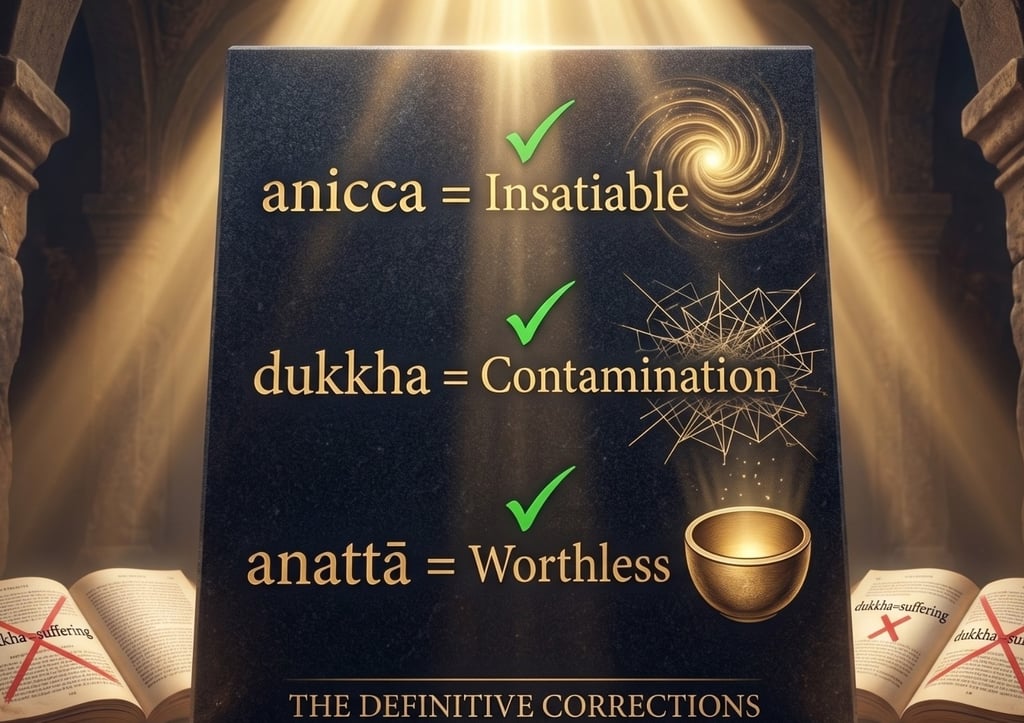

Beyond Suffering and No-Soul: Redefining the Three Marks of Existence.
How Mental Fabrication Creates Confusion in Buddhist Practice
In Buddhist teaching, some of the most important words are also the most misunderstood.
Not because they are complex but because they were never meant to be frozen into definitions.
Dukkha and Anattā are two such words.
When they are translated loosely or taught without context, they turn living insight into philosophy.
To understand them clearly, we must return to Nirutti the way the Buddha explained meaning through experience, not labels.
Dukkha Is Not Suffering
Dukkha is commonly translated as suffering.
But this translation points attention in the wrong direction.
Dukkha does not describe what happens in the world.
It describes what the mind adds.
The outside world, as the Buddha pointed out, is fundamentally neutral.
Dukkha arises only when mental fabrication begins.
In Nirutti, Dukkha appears in three modes, each showing how the mind constructs strain where none inherently exists.
Sankhāra Dukkha Fabrication Through Greed
This arises when something is seen and the mind adds craving.
An object appears.
The mind imagines continuation, possession, fulfillment.
At first, this feels pleasant.
But the strain is already present because what is fabricated must be maintained.
The discomfort does not come from the object.
It comes from the effort to hold what cannot be secured.
Dukkha Dukkha Fabrication Through Aversion
Here, something is seen and the mind adds resistance or anger.
The object itself remains neutral.
But the mind tightens, opposes, rejects.
This form of Dukkha is easier to recognize because it feels unpleasant.
Yet its source is the same mental addition, not the world.
Vipariṇāma Dukkha Fabrication Through Delusion
This is the most subtle.
A pleasant fabrication fades.
An unpleasant state dissolves.
Meaning collapses back into neutrality.
The mind feels unsettled not because something was lost,
but because it depended on fabrication to feel complete.
This is why even pleasure contains dissatisfaction.
The Core Meaning of Dukkha
Dukkha is not what happens.
Dukkha is what the mind fabricates.
When fabrication stops, Dukkha stops not because the world changes,
but because nothing extra is added.
Press enter or click to view image in full size
By Beyond The illusion
Anattā Is Not “No Soul”
Anattā is often translated as no self or no soul.
This translation has caused deep confusion.
The Buddha explicitly refused to take either position:
“There is a soul”
“There is no soul”
Why?
Because both are fabrications.
What Anattā Actually Points To
Anattā does not deny existence.
It points to non-ownership.
The outside world is neutral.
Ownership, identity, and control arise only in the mind.
Anattā means:
Fabrication is not worth holding
Identification is unnecessary
Nothing needs to be claimed as “mine”
Why “No Soul” Misses the Point
Saying “there is no soul” still assumes:
something to deny
something to define
something to argue about
The Buddha did none of this.
Instead, he showed that when fabrication ceases,
the need to define self or no-self disappears.
This is not annihilation.
It is freedom from construction.
The Core Meaning of Anattā
When nothing is fabricated,
there is nothing to defend, deny, or own.
That release is Anattā.
How Anicca, Dukkha, and Anattā Fit Together
Seen through Nirutti, these are not three ideas they are three aspects of one insight:
Anicca - fabrication cannot satisfy
Dukkha - fabrication creates strain
Anattā - fabrication is not worth owning
This is not philosophy.
It is a way of seeing experience directly.
Why This Matters Today
Much of modern spiritual practice focuses on techniques.
But without clear seeing, practice remains within fabrication.
This is why sincere effort can continue for years
without touching the end of Dukkha.
The issue is not discipline.
It is where understanding begins.
A Note on Transmission
The Buddha taught through Nirutti, adapted explanation, and living guidance through a chain of Kalyāṇa-mitta, not books alone.
Words are only pointers.
Meaning opens through right explanation, wise attention, and direct seeing.
Read it slowly.
Then return with reflection.
From there, the path unfolds naturally without force.
Beyond The Illsuion
Nuwan Buddika