
Historical Translations Error
Why seeing Anicca as mere change misses the deeper insight the Buddha pointed to.
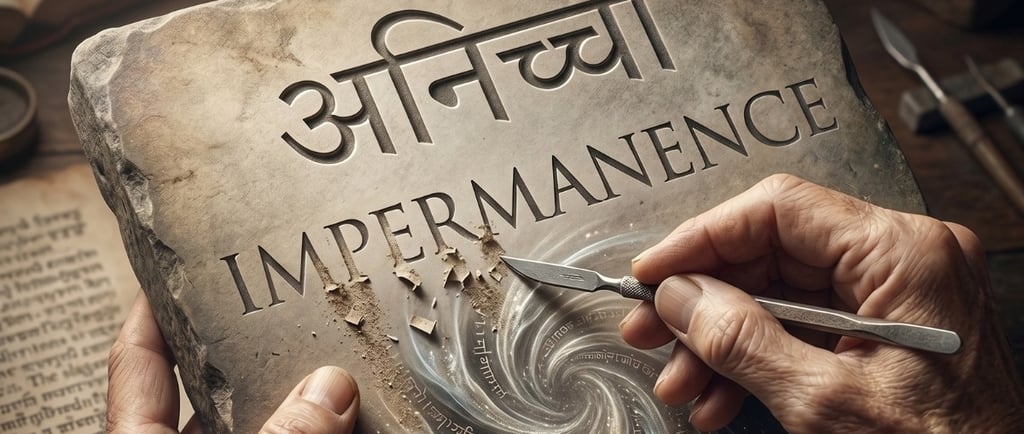
The Fatal Translation Error: Why Anicca Is Not “Impermanence.”
Introducing the clear path from the beginning to end
Many people come to the spiritual path not because life is comfortable, but because something quietly feels incomplete.
Meditation is often taken up as the solution yet without clear seeing, meditation becomes another activity performed inside the same confusion.
In Buddhist teaching, wisdom always comes before practice. Without this order, even sincere effort can drift away from the path it hopes to reach.
In Buddhist teaching, enlightenment is not a single category.
The Buddha spoke of three types of awakening (Bodhi):
Sammāsambuddha-one who discovers the path by themselves and can fully teach it to others.
Paccekabuddha-one who realizes the truth by themselves but cannot effectively teach it.
Sāvaka Buddha -one who realizes awakening through guidance, hearing the Dhamma from another.
So, under Gauthama Buddha now still remaining ( Sāvaka Buddha one who realizes awakening through guidance, hearing the Dhamma from another)
The Buddha emphasized the importance of the spiritual friend (Kalyāṇa-mitta) not as a social companion, but as one who has seen the way out.
In the Sotāpanna Sutta, the Buddha points out that stream-entry arises only when certain conditions meet not by chance, and not by technique alone. And no one can achieve themself alone this deep Dhamma they have to go through as below steps,
Association with a true spiritual friend
Hearing the true Dhamma
Wise attention (yoniso manasikāra)
Right practice (paṭipadā)
Today, many speak about enlightenment, mindfulness, or awakening without having touched liberation themselves.
Words are shared, techniques are taught, but the seeing that ends suffering is often absent.
This is not a moral failure it is a structural one. Teaching is occurring without realization, and practice is being emphasized without wisdom.
When guidance comes from theory alone, it may sound convincing yet it cannot carry someone beyond illusion.
The Beyond the Illusion book series was not created to add another voice to spiritual noise.
It was created to restore sequence seeing before doing, wisdom before technique, clarity before meditation.
What is shared there comes from lived inquiry, not borrowed language.
The intention is simple:
to help seekers recognize where they are standing, and what must be seen before the next step can arise.
Not everyone is ready for this kind of seeing and that is natural.
But for those who feel meditation has not delivered what was promised, the issue may not be effort. It may be where the path was entered.
When wisdom is restored to its rightful place, practice stops wandering and the path becomes clear again.
Where the Translation Error Began
The Buddha’s teaching was not originally meant to be understood through books alone.
It moved through a living chain of Kalyāṇa-mitta one who had seen the way guiding another who was ready to see.
When this living transmission weakened, the Dhamma slowly shifted from direct seeing to conceptual explanation.
Words remained, but their pointing function was gradually lost.
This is where a subtle yet powerful error entered.
Anicca Is Not Impermanence
Today, Anicca is almost universally translated as impermanence.
While change is certainly observable, this translation misses the core insight the Buddha was pointing to.
Anicca does not primarily refer to the fact that things change.
It points to something deeper:
That which is mentally fabricated can never satisfy.
The mind grasps, expects, repeats, and seeks fulfillment yet gratification remains incomplete.
Not because objects disappear, but because craving itself is insatiable.
Seeing Anicca is not an observation of time.
It is the recognition that no constructed experience can be made secure.
When Anicca is reduced to “everything changes,” the path becomes philosophical.
When Anicca is seen as unsatisfiable fabrication, the path becomes liberating.
Why This Matters for Practice
If Anicca is misunderstood, practice turns outward.
Meditation becomes a method to manage life rather than a way out of illusion.
This is why many practice sincerely for years yet feel something essential is missing.
The problem is not effort it is what was seen as the problem in the first place.
The Buddha did not teach Anicca to make us tolerate change.
He taught it to reveal the futility of clinging.
What Comes Next
This article focuses only on Anicca, because clarity must arise one step at a time.
In the next articles, we will explore:
Why Dukkha does not simply mean suffering
Why Anattā does not mean “no soul”
And how these misunderstandings quietly reshape modern spiritual practice
Each insight builds upon the previous one just as the Buddha taught.
How the Buddha Pointed to Meaning
In the Buddha’s time, the Dhamma was not delivered as fixed definitions.
It was explained through Nirutti (Nirukthi) contextual, experiential explanation, adjusted to the listener’s capacity.
Because of this, the same teaching could open differently in different minds.
Meaning did not lie in the word itself, but in how the word was heard and seen.
When this method is lost, the Dhamma becomes literal.
And when it becomes literal, insight turns into interpretation.
This is why many core terms Anicca, Dukkha, Anattā have come to be understood as static meanings rather than direct pointers to seeing.
If you wish, read it slowly.
Then return with questions or reflections.
From there, we can move carefully into the deeper meanings of Dukkha and Anattā, without forcing conclusions or skipping steps.
Clarity unfolds in sequence.
Beyond The Illusion
By Nuwan Buddika